


Keeping it Simple and Sweet

This graphic cought my eye.  It was on Linked-in.  No-one doubts the value of keeping things simple, but simplicity is; paradoxically, hard to achieve.   One might venture to say simplicity is “complex”.   Keeping our messages simple and  clear is a challenge we all face daily.  Be it a sales message, creative pitch, reporting to the boss – messaging is hard.   Should there exist a (complex)  system for simplifying messaging?  I say YES!  And it should not be that complex…..maybe a little.  We shall see.Simplicity is a concept we all strive for, yet achieving it can be surprisingly complex. Whether it’s conveying a sales pitch, presenting a creative idea, or reporting to our superiors, crafting clear and concise messages poses a daily challenge. Is there a method for simplifying messaging without adding unnecessary complexity? I believe there is, and it shouldn’t be overly complicated… perhaps just a tad. Let’s explore.


“Simplicity is Complex”

Me, just now.

1- The Hedgehog Knows One Thing

In his book “Good to Great: Why Some Companies Make the Leap… and Others Don’t,” author James C. Collins illustrates the point that the Hedgehog has one clear strategy that consistently works, while the Fox has many plans. When it comes to getting your message across, adopt the Hedgehog mindset. Lead with what’s proven to work. Elevator pitches thrive with this approach, especially when paired with a compelling hook. For example, phrases like “It’s like UBER for hairdressers” or “Netflix for E-Learning” instantly resonate with people, even if the concept is more nuanced.


2- The Mouse Trap Principle

The mouse trap exemplifies the principle of irreducible complexity in engineering. Remove any component, and it ceases to function. While some argue that cars contain redundant parts, the distinction lies in the organization of these components into systems. These systems, whether independent or interdependent, benefit greatly from the principle of irreducible complexity. The same applies to messaging.

Let me break it down for you…

…You got to break it down.  Your messaging.   Truncate the Capitol T out of it!   Simplify your messaging, following the Hedgehog’s lead with proven strategies. Then, streamline it further, ensuring the message remains coherent, akin to the Mousetrap principle. Here’s a bonus tip: Avoid bombarding recipients with multiple questions in a single email. Stick to one topic per email. This approach not only spares the reader and yourself from frustration but also helps prioritize what truly matters.
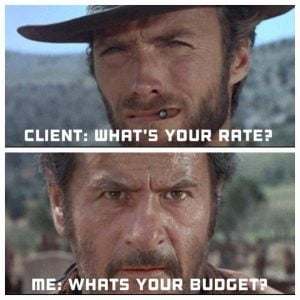

Budget vs. Rate

The Race to the Bottom

the Good the Bad the Ugly

As I stumbled upon a Clint Eastwood meme, depicting him as the client, coolly asking, “What is your rate?” while staring down a bandito, representing the server provider, who responds with the classic counter, “What is your budget?”—it struck me. This negotiation dance, familiar to many, holds a deeper truth that deserves exploration.

In the realm of the audiovisual (AV) industry, negotiations often feel like a tug-of-war where the middleman, the event organizer, holds the ropes, ready to exploit the service provider’s vulnerabilities. The threat of cheaper, albeit less experienced and equipped alternatives looms, pushing service providers into a corner. But let’s pause and reflect: Isn’t this absurd?

Price, in its essence, isn’t determined by a set formula but rather by market forces—supply, demand, and perceived value. Yet, the pressure to cut costs and pit service providers against each other fuels a race to the bottom. As corners are cut and rates slashed, the standard of service declines, tarnishing the industry’s reputation.

The solution lies not in yielding to the pressure but in standing firm. While the AV industry lacks regulation or unionization, establishing a consensus on industry rates is paramount. Service providers must resist the urge to compromise quality for the sake of securing contracts. Instead, they should focus on adding value, enhancing services, and easing the burden on event organizers.

By positioning themselves as indispensable partners invested in the client’s peace of mind, service providers can shift the narrative. Paying the full rate becomes an investment in quality, reliability, and professionalism—a far cry from the race to the bottom mentality.

Furthermore, investing in young talent through internships benefits both parties. Service providers gain access to fresh perspectives and skills while offering mentorship opportunities. This not only improves the quality of work but also ensures the industry’s vitality in the long run.

Collaboration is key. Larger and smaller video production companies should join forces to elevate industry standards collectively. Take a smaller production company under your wing and throw it a bone every now and then. This collaborative effort will not only fosters financial success but also shields the industry from the chaos of market forces.

In conclusion, let’s reimagine negotiations in the AV industry. Let’s prioritize quality over cost, collaboration over competition, and mentorship over exploitation. By doing so, we not only elevate our craft but also secure a brighter future for all involved.

Rhythm of Life: Grooving with Sting and the 80/20 Rule

Let me take you on a journey, not just any journey, but a groove-infused exploration into the heart of life itself. Picture this: the year is 1985, and Sting, the legendary frontman of The Police, decides to go solo. But to create his new band, he needed a percussionist who could vibe with his bass like nobody’s business.

Legend has it that Sting held open auditions, welcoming drummers of all stripes to try their luck. One by one, they stepped into the spotlight, eager to impress. But there was a catch – Sting asked them to do something simple: play a straightforward 4/4 beat. A piece of cake, right?

The first drummer, bursting with enthusiasm, launched into a thunderous snare roll, hoping to dazzle Sting with his flair. But Sting, with a knowing smile, politely thanked him and showed him the door. The next few drummers followed suit, each adding their own twist – tom cycles, ghost notes, you name it. But none of them hit the mark.

And then, in walked Vinnie Colaiuta. There was something about the way he carried himself, a quiet confidence that spoke volumes. He didn’t need flashy tricks or gimmicks. No, Vinnie knew that sometimes, less is more.

With a nod from Sting, Vinnie settled behind the drum kit, adjusted his seat, and began to play. And oh, what a sight it was! He locked into the rhythm like it was second nature, each beat ringing out with precision and soul. Vinnie, played on. And Vinnie Played on. Sting recalled that it must have been 10 minutes that Vinnie played the 4/4 beat without deviating from the instruction to do so. Not speeding up. Not slowing down. Not going louder. Not playing softer. It was as if time itself stood still. As Sting joined in, his bass intertwining with Vinnie’s drums in a dance of pure musical bliss.

Podcasting service, video production Cape Town

As they jammed, the room filled with an electrifying energy, each note echoing the passion and dedication of two artists in perfect harmony. And in that moment, it became clear – Sting wasn’t just looking for a drummer; he was searching for a kindred spirit, someone who understood the power of simplicity and the beauty of a well-crafted groove.

But this tale isn’t just about music; it’s about life itself. You see, embedded within this musical anecdote lies a profound truth – the 80/20 rule, also known as the Pareto Principle. It’s the idea that 20% of our efforts yield 80% of our results, a concept as timeless as it is powerful.

Think about it: 20% of your skills drive 80% of your success. 20% of your time produces 80% of your output. It’s the principle of focus, of honing in on what truly matters and letting go of the rest.

The trick is here to execute flawlessly 80% of the time – to the point – when it matters most. The other 20% of the time you can peak to see what is in the bag of tricks.

In another blog post I will go into more detail about Zipf’s Law.  Both was mentioned in the Video above.  Using these to universal powers together are a great productivity boost.